

Why calibration material deserves more attention
When engineers discuss calibration artifacts, the conversation usually focuses on:
- diameter accuracy
- roundness
- manufacturing tolerance
However, one factor is often overlooked:
Material performance.
The material of a reference sphere directly affects long-term stability and measurement reliability.
Why ceramic spheres are widely used
Ceramic materials have become popular in precision metrology because they provide several advantages:
- high hardness
- good dimensional stability
- corrosion resistance
- excellent surface finish capability
For many CMM applications, ceramic spheres provide reliable performance at a reasonable cost.
They are widely used for:
- probe calibration
- general inspection
- laboratory measurement
Why ruby spheres are different
Ruby is a special type of synthetic gemstone material with extremely high hardness.
Its advantages include:
- excellent wear resistance
- stable geometry
- low surface degradation
- long service life
Because of these characteristics, ruby spheres are often selected for applications where measurement consistency is critical.
The importance of long-term stability
In production environments, calibration artifacts are not used only once.
They may be used:
- daily
- weekly
- thousands of times during their service life
Small changes accumulated over time can eventually influence measurement results.
For high-demand applications such as CT calibration, maintaining stable reference geometry is especially important.
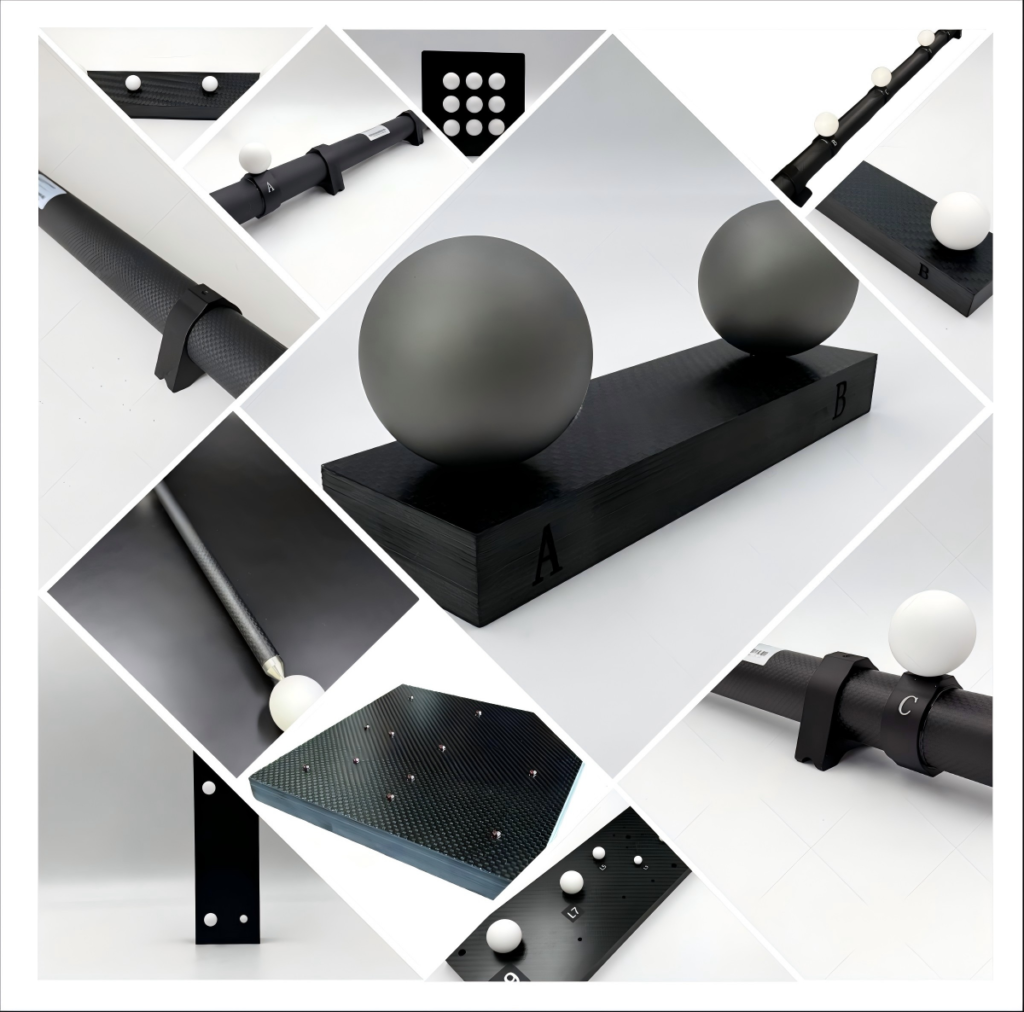
This is why a Ruby Plate for CT System is increasingly considered for applications requiring long-term dimensional reliability.
Choosing based on application requirements
The correct material depends on the measurement environment.
Ceramic may be suitable for:
- standard CMM verification
- general laboratory applications
- cost-sensitive projects
Ruby may be preferred for:
- high-frequency calibration
- advanced CT measurement
- high-precision research environments
- applications requiring long-term stability
Precision is not only about initial accuracy
A common misunderstanding is that the most precise artifact is the one with the smallest initial error.
In reality, engineers care more about:
- repeatability
- stability
- predictable behavior
An artifact that remains stable for years may provide more value than one that achieves excellent results only under initial conditions.
Final thoughts
Material selection is an important part of calibration engineering.
Ceramic and ruby are both excellent materials.
The right choice depends on the application, required stability, and measurement environment.
In precision metrology, long-term confidence is often more important than a single impressive specification.