

The challenge of large-scale precision measurement
Modern manufacturing continues to create larger and more complex components.
Examples include:
- aircraft structures
- automotive body systems
- wind energy components
- large industrial equipment
Inspecting these components requires measurement systems with larger working volumes.
However, large measurement volume creates a significant challenge:
Maintaining accuracy while increasing size.
Why traditional materials become difficult at large scale
Metal structures have been widely used in measurement equipment.
However, when structures become larger, several problems appear:
- increased weight
- thermal expansion
- transportation difficulty
- deformation risk
Even small dimensional changes can affect high-precision measurement.
Advantages of carbon fiber in metrology applications
Carbon fiber composites provide several important advantages:
Lightweight structure
Large calibration systems become easier to handle and transport.
High stiffness
Carbon fiber provides excellent stiffness-to-weight performance.
This helps reduce structural deformation.
Low thermal expansion
Temperature changes have less influence compared with many traditional materials.
This improves long-term stability.
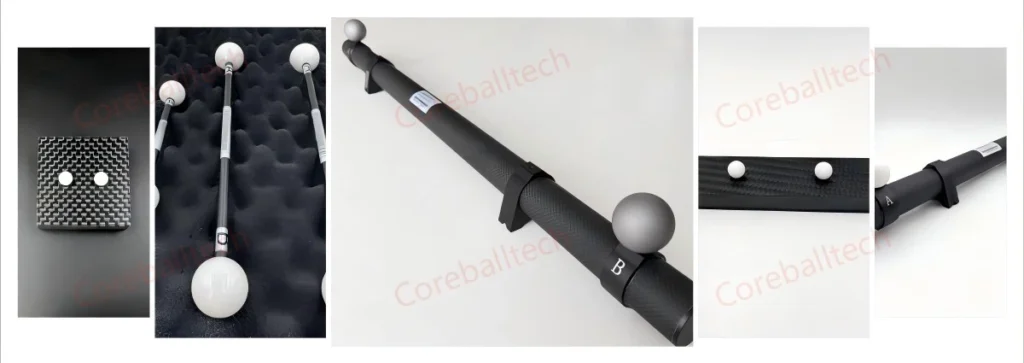
Carbon fiber and calibration artifacts
Large-volume measurement often requires reference systems such as:
- long ball bars
- reference frames
- calibration structures
A carbon fiber structure can support precision reference components while maintaining dimensional stability.
For example, a carbon fiber ball bar can provide:
- long measuring length
- lightweight handling
- improved thermal performance
Applications of carbon fiber calibration structures
Carbon fiber-based calibration solutions are increasingly used in:
- large CMM verification
- laser tracker measurement
- 3D scanner calibration
- aerospace inspection
These applications require both:
Large measurement coverage
and
High geometric stability.
Combining carbon fiber with precision spheres
The structure alone is not enough.
The reference elements mounted on the structure must also maintain accuracy.
A typical high-performance system may combine:
- carbon fiber support structure
- ceramic calibration spheres
- precision mounting technology
This combination provides both stability and measurement reliability.
Engineering perspective
The future of industrial measurement is moving toward:
- larger volumes
- faster inspection
- multi-sensor integration
Carbon fiber provides an effective solution for meeting these challenges.
Final thoughts
Large-volume metrology requires materials that can maintain accuracy without creating excessive weight or instability.
Carbon fiber is becoming an important engineering material for next-generation calibration systems.