

Industrial CT calibration behaves differently from standard CMM calibration.
The geometry still matters, of course.
But now you are also dealing with:
- X-ray penetration
- reconstruction algorithms
- material density
- imaging contrast
That changes how calibration artifacts behave.
Stable geometry becomes even more important
CT systems rely heavily on reconstruction consistency.
If the calibration artifact itself is unstable, reconstruction quality drops very quickly.
This affects:
- edge detection
- dimensional consistency
- volumetric accuracy
That’s one reason spheres are widely used in industrial CT calibration.
They remain easier to reconstruct reliably compared to complex geometries.
Material choice affects CT performance directly
This is not just about hardness anymore.
Different materials interact differently with X-rays.
That affects:
- image contrast
- edge visibility
- reconstruction quality
Common materials include:
- ceramic
- ruby
- tungsten carbide
Each behaves differently depending on the scanning setup.
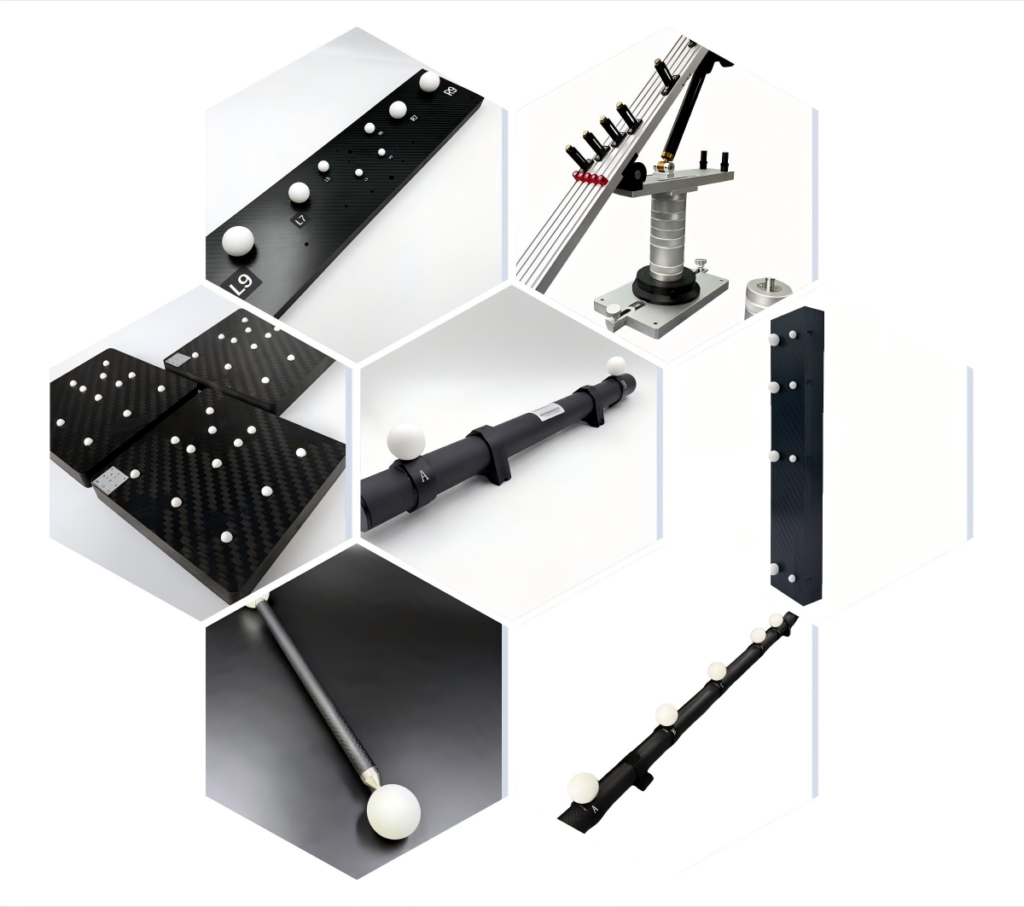
Why ball plates are commonly used in CT systems
Single spheres provide local geometry information.
Ball plates provide spatial reference across multiple regions.
That makes them much more useful for detecting:
- volumetric distortion
- scaling behavior
- reconstruction drift
- alignment instability
Especially in larger CT volumes.
More complexity is not always better
This is another common misunderstanding.
Some users assume:
“More spheres means higher calibration quality.”
Not always.
Complex artifacts introduce:
- more fitting variables
- more alignment sensitivity
- more reconstruction dependency
If the setup itself is unstable, a complicated artifact may actually make troubleshooting harder.
Surface condition still matters
Even in CT systems, surface quality affects results.
Damage, contamination, or poor geometry still reduce fitting consistency.
Stable reconstruction depends on stable reference geometry.
That never changes.
What experienced engineers usually prioritize
Not maximum complexity.
Usually they focus on:
- stable geometry
- repeatable positioning
- predictable reconstruction
- consistent fitting behavior
Because those factors produce reliable long-term calibration results.
Final thought
The best CT calibration artifact is not necessarily the most advanced-looking one.
Usually it’s the one producing stable and repeatable reconstruction behavior under real working conditions.