

Most point cloud distortion problems do not start where people think.
When users see:
- warped geometry
- misalignment
- uneven surfaces
- drifting edges
the first reaction is usually:
“The scanner accuracy is bad.”
Sometimes that’s true.
But often the real problem starts much earlier in the workflow.
Calibration instability is usually the first thing to check
If calibration itself is unstable, distortion accumulates across the entire measurement volume.
This becomes especially obvious in:
- larger scanning areas
- multi-angle reconstruction
- stitched point clouds
A scanner may look accurate locally while still drifting globally.
That’s a common situation.
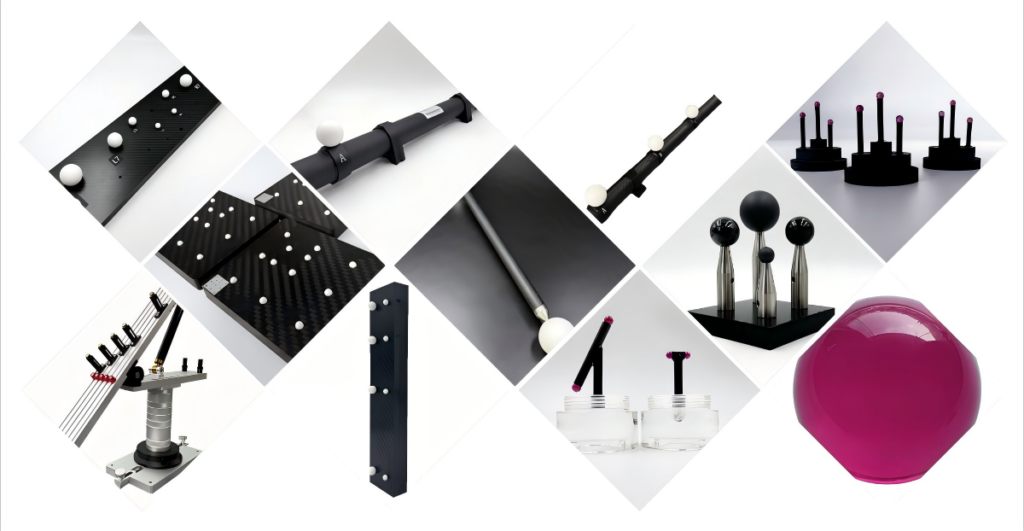
Poor artifacts create misleading results
This happens more often than people admit.
If the calibration artifact has:
- poor roundness
- unstable surface quality
- inconsistent geometry
then fitting results become unreliable.
The scanner may appear inconsistent even though the actual issue comes from the reference artifact.
Reflection problems are underestimated
Highly reflective surfaces create major problems in optical systems.
Especially when scanning from multiple angles.
Typical issues include:
- noisy regions
- unstable edges
- missing point cloud areas
- reconstruction artifacts
This is one reason diffuse surfaces are widely used in scanner calibration.
Scanner angle changes everything
Scanning geometry matters.
At aggressive scanning angles:
- point density changes
- edge quality decreases
- occlusion increases
Even good scanners struggle under poor geometric conditions.
That’s why experienced operators constantly adjust scanning direction instead of relying on a fixed setup.
Thermal drift quietly accumulates
This one is subtle.
Optical systems warm up during operation.
Over time:
- sensor behavior shifts
- internal geometry changes slightly
- reconstruction stability decreases
The user may only notice the problem after longer scanning sessions.
Software is not always the main problem
A lot of people blame reconstruction software immediately.
But experienced engineers usually check other things first:
- artifact condition
- environmental stability
- calibration repeatability
- scanning consistency
Because those are more common failure sources.
Final thought
Point cloud distortion usually comes from multiple small instabilities interacting together.
Rarely from one catastrophic failure.
That’s why stable calibration practice matters much more than people expect.