

Introduction
In the field of 3D metrology, ensuring measurement accuracy is critical for industries ranging from aerospace to industrial manufacturing. As 3D scanning technologies continue to evolve, the need for reliable calibration tools becomes increasingly important.
The Tripod Ball calibration frame is designed as a high-precision reference artifact, providing a stable and traceable solution for verifying and calibrating 3D optical scanning systems.
What is a Tripod Ball Calibration Frame?
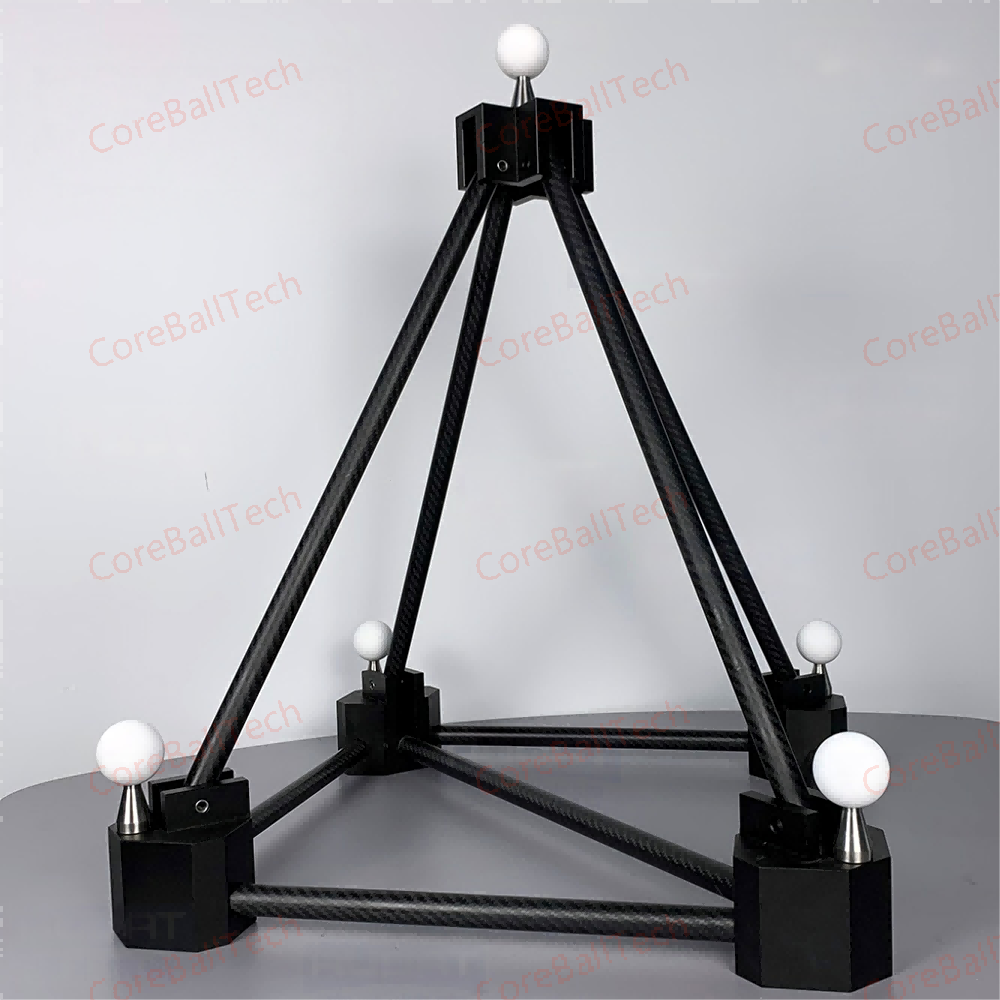
A Tripod Ball calibration frame is a precision-engineered structure that integrates multiple high-accuracy ceramic spheres into a rigid triangular framework.
The system typically includes no fewer than four standard balls arranged in a non-coplanar configuration. This spatial arrangement enables accurate geometric referencing, making it ideal for validating volumetric accuracy in 3D scanning systems.
Each ball has a diameter of at least 25mm, with roundness superior to one-third of the measurement error of the tested device, ensuring reliable calibration performance.
Key Design Advantages
1. Stable Triangular Structure
The tripod configuration provides excellent structural stability. Combined with a carbon fiber frame, it minimizes deformation and ensures consistent spatial relationships between calibration points.
2. High Precision Ceramic Balls
The use of ceramic standard balls guarantees exceptional hardness, wear resistance, and dimensional stability. This ensures long-term accuracy and repeatability.
3. Non-Coplanar Sphere Distribution
Unlike planar calibration artifacts, the non-coplanar arrangement of spheres allows for true 3D spatial calibration, significantly improving measurement reliability.
4. Large Calibration Volume
With a maximum center distance exceeding 500mm, the Tripod Ball system supports calibration for medium to large measurement volumes, making it suitable for a wide range of scanning systems.
5. Low Calibration Uncertainty
The distance uncertainty between any two spheres is controlled within U ≤ 5μm (k=2), ensuring traceable and high-precision measurement results.
Applications in 3D Scanning Systems
The Tripod Ball calibration frame is widely used in systems based on structured light and laser scanning technologies, including:
- Fringe projection (structured light) 3D scanners
- Handheld laser line scanners
- Industrial optical measurement systems
Typical measurement ranges include:
- Structured light systems: up to 2000 × 1500 × 1500 mm
- Handheld laser scanners: up to 275 × 250 mm scanning range with depth up to 250 mm
This makes the Tripod Ball system a versatile calibration tool across various inspection environments.
Why Calibration Matters
Without proper calibration, even the most advanced 3D scanners can produce inaccurate or inconsistent results. Calibration ensures:
- Measurement accuracy and repeatability
- System reliability
- Compliance with quality standards
- Confidence in inspection data
Using a high-precision Tripod Ball calibration frame helps eliminate systematic errors and improves overall measurement confidence.
Choosing the Right Calibration Solution
When selecting a calibration artifact, it is important to consider:
- Measurement volume requirements
- Required accuracy level
- Material stability
- Environmental conditions
The Tripod Ball calibration frame offers a balanced solution with high precision, structural stability, and adaptability to different scanning technologies.
Conclusion
As 3D scanning continues to play a critical role in modern manufacturing and quality control, reliable calibration tools are essential.
The Tripod Ball calibration frame provides a robust, accurate, and industry-ready solution for ensuring the performance of 3D optical measurement systems. Its combination of high-precision ceramic spheres, stable structure, and low uncertainty makes it an indispensable tool for professionals seeking reliable measurement results.