

Start with a practical question
If you are calibrating a 3D scanner, should you use a single ball or a ball plate?
The answer depends on what you are trying to verify.
Calibration ball – simple but limited
A single calibration ball is useful for:
- Checking local geometry
- Verifying basic accuracy
- Quick validation
But it has a limitation:
👉 It does not tell you how the system behaves across space
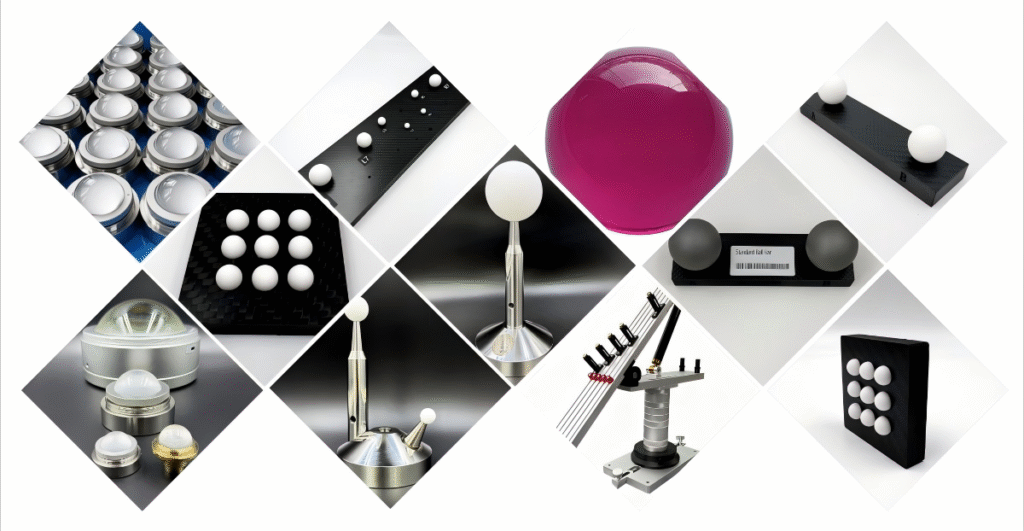
Ball plate – more information, more complexity
A ball plate includes multiple spheres fixed in a defined pattern.
This allows you to check:
- Spatial distortion
- Alignment accuracy
- Multi-point consistency
For 3D scanners, this is often more meaningful.
When to use each
From experience:
Use a calibration ball when:
- You need quick checks
- You are verifying a probe or sensor
- Setup needs to be simple
Use a ball plate when:
- You care about full-field accuracy
- You are validating scanning systems
- You need repeatable spatial results
A common misunderstanding
Some users think:
👉 “More spheres = always better”
Not necessarily.
More geometry means:
- More data
- But also more variables
If your setup is not stable, a ball plate may make results harder to interpret.
Final thought
Calibration tools are not interchangeable.
A calibration ball tells you how accurate a point is.
A ball plate tells you how accurate the whole system is.