

Start with the confusion
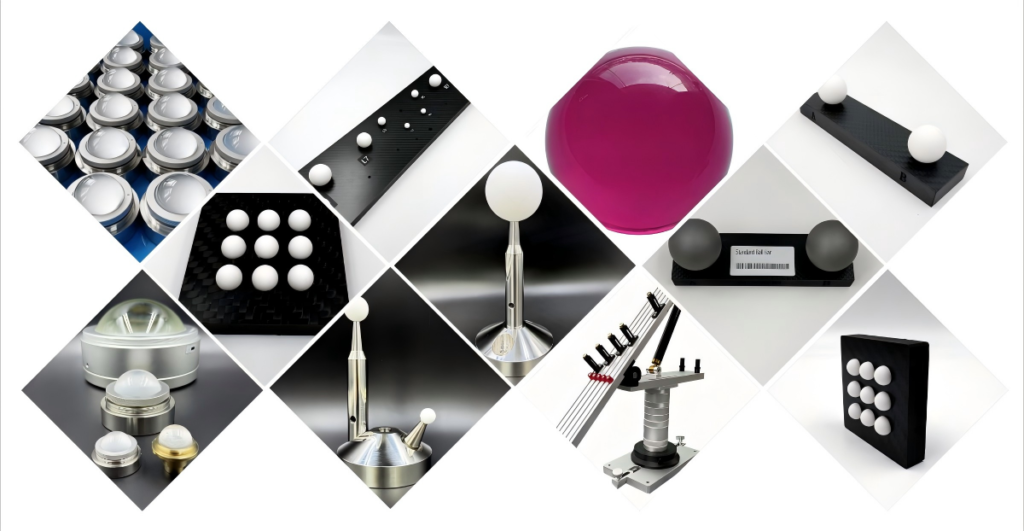
There are many calibration artifacts available:
- Calibration ball
- Ball bar
- Ball plate
- Grid targets
Which one is best?
The answer depends on what you want to check.
1. Calibration ball – simple and reliable
Use when:
- You want quick verification
- You need stable geometry
- You are checking local accuracy
Good for:
- Initial setup
- Sensor validation
But limited in spatial information.
2. Ball bar – good for distance behavior
Use when:
- You want to check consistency between points
- You need to evaluate alignment
It gives more information than a single sphere, but still limited in coverage.
3. Ball plate – full system check
Use when:
- You care about full-field accuracy
- You want to detect distortion
- You need repeatable calibration
For most 3D scanners, this is the most complete solution.
4. Grid targets – fast but less stable
Often used in vision systems.
Pros:
- Easy to detect
- Fast processing
Cons:
- Sensitive to lighting
- Less stable than spheres
What engineers actually choose
In real applications:
- Quick check → calibration ball
- System check → ball bar
- High accuracy → ball plate
Final thought
No artifact is “best”.
It depends on what error you are trying to see.