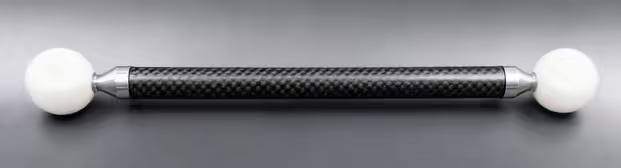
Start with a simple truth
If your calibration result looks bad, it’s usually not just one problem.
It’s a combination of small things:
- Sphere quality
- Probe or scanner behavior
- Setup
- Environment
And they stack together.
1. Sphere quality — the part people assume is perfect
Most people trust the sphere by default. That’s not always safe.
What actually matters:
- Roundness
- Diameter consistency
- Surface condition
If the sphere has even small form error, it will show up immediately in fitting results.
And the tricky part is—you might think it’s a machine problem.
2. Material — only noticeable over time
At first, different materials behave similarly.
But over time:
- Steel can drift with temperature
- Ceramic stays more stable
- Carbide resists wear better
If you’re doing repeated calibration, material choice starts to matter more than you expect.
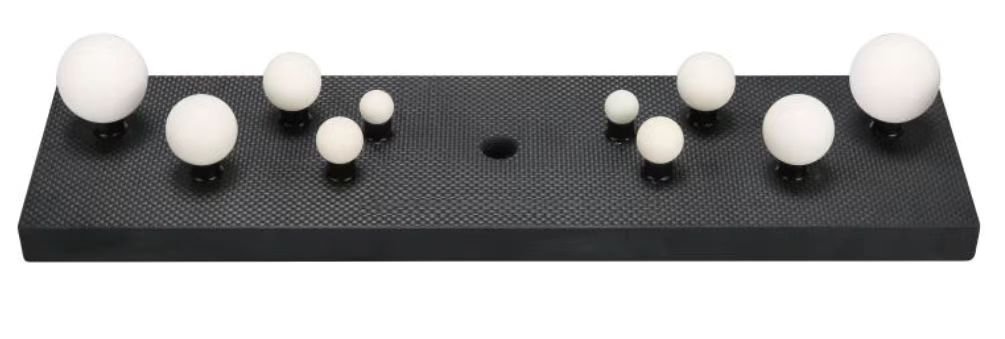
3. Probe vs 3D scanner — completely different error sources
For CMM:
- Probe calibration
- Stylus length and stiffness
- Contact force
For 3D scanners:
- Point cloud noise
- Resolution
- Alignment algorithms
Same artifact, different problems.
That’s why sometimes a setup looks fine on a CMM but unstable in a scanner.
4. Measurement strategy — often underestimated
People follow standard point patterns, but don’t think about why.
What actually affects accuracy:
- Are points evenly distributed?
- Are you repeating the same angles?
- Are you missing critical regions?
More points doesn’t always mean better results.
Better distribution usually does.
5. Environment — small changes, big impact
Temperature is the obvious one, but not the only one.
Also watch:
- Airflow (especially near scanners)
- Machine vibration
- Thermal gradients across the bar
Even a small shift can change center distance results.
6. Setup stability — the silent error source
If the ball bar is not rigidly fixed:
- Data will look inconsistent
- Results will not repeat
This is often misdiagnosed as machine error.
7. Data processing — good math won’t fix bad data
Most systems use least squares fitting.
That’s fine.
But if:
- Your points are uneven
- You include bad regions (like near the stem)
- Or you have noise (scanner case)
Then the result is still wrong.
What actually matters in the end
Engineers usually don’t care about every number.
They care about:
👉 Are the results repeatable?
👉 Do distances stay consistent?
👉 Does the system behave the same over time?
Final thought
Calibration accuracy is not about one perfect component.
It’s about how well everything works together under real conditions.
And that’s why two setups with the same equipment can give very different results.