

Start from how it’s actually used
In theory, a ball bar is just a bar with several precision spheres.
In practice, it’s used when a single calibration ball is not enough.
If you only check one sphere, you are mostly verifying local probing accuracy.
But once you care about distance, alignment, and volumetric behavior, you need something like a ball bar.
That’s where it becomes useful.
What problem does it really solve?
A ball bar lets you look at two things at the same time:
- How “good” each sphere is (diameter and form)
- How the system behaves between spheres (distance and positioning)
That second part is the reason people use it in:
- CMM verification
- 3D scanner calibration
- Optical systems
Especially in 3D scanning, you don’t just care about one point—you care about how the whole space fits together.
Why spheres, not other shapes?
This is actually a practical choice.
Spheres are used because:
- They are easy to probe
- They are mathematically stable to fit
- They don’t depend on orientation
Compared to planes or edges, spheres are much more forgiving in real measurement environments.
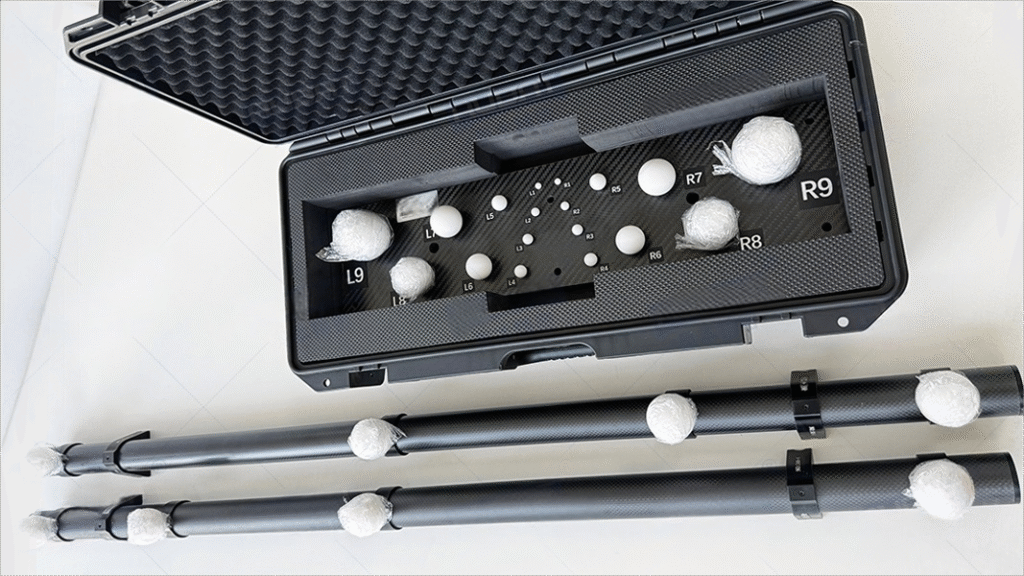
Materials — not just a spec sheet choice
You’ll typically see:
- Steel
- Carbide
- Ceramic
On paper, they all work.
But in real use:
- Steel → more sensitive to temperature
- Carbide → very stable but heavier
- Ceramic → usually the safest choice for long-term use
That’s why many high-precision setups move toward ceramic spheres.
Surface finish depends on the system
This is often overlooked.
- Polished surface → better for contact probing (CMM)
- Matte / diffuse surface → better for optical and 3D scanners
If you mix them incorrectly, you’ll get unstable data, especially in scanning systems.
Where it matters most (CMM vs 3D scanner)
In CMM:
- You’re checking probing behavior and geometry
In 3D scanning:
- You’re checking point cloud alignment
- And whether distances stay consistent across space
A single sphere won’t show that. A ball bar will.
A small but important detail
When measuring, always avoid the mounting or stem area.
That region is never ideal geometrically.
If you include it in your data, your fitting result will look worse than it actually is.
Final thought
A ball bar is not a “basic tool”.
It’s something you use when you start caring about how accurate your system is in space, not just at a point.