

The common debate
In the world of metrology, both ball bars and calibration balls are important tools, but which one should you use for a given situation?
While both serve a similar function, their application is different.
When to use a calibration ball
A calibration ball is great when you only need to check diameter accuracy and form error for individual components. It’s the go-to tool for quick checks on CMM systems.
However, if you are working with:
- Volumetric measurements
- Multi-point evaluations
Then a ball bar is more suitable.
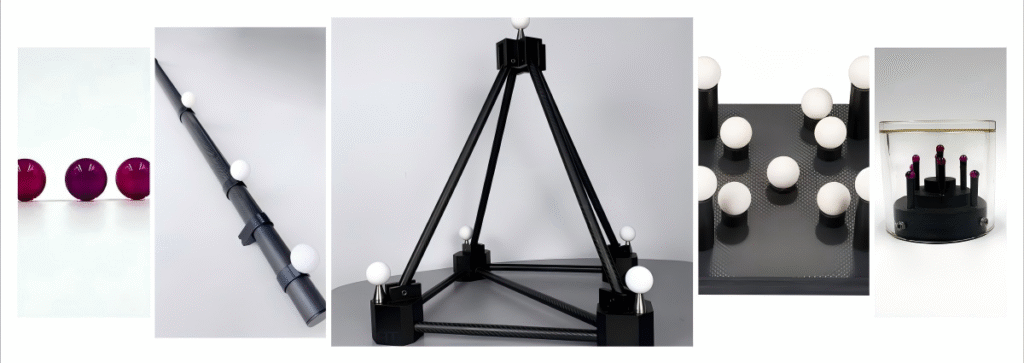
When to use a ball bar
A ball bar is preferred when:
- You need to check system behavior across multiple points
- You’re concerned about center-to-center distance accuracy
- You need to verify the system’s volumetric accuracy
Comparing the two
| Factor | Calibration Ball | Ball Bar |
|---|---|---|
| Precision | High, for single point | High, for system-wide |
| Usage | Checking local sphere accuracy | Verifying CMM and 3D scanner alignment |
| Cost | Lower | Higher (due to complexity) |
| Ideal for | Smaller setups, quick checks | Larger systems, full volumetric checks |
Conclusion
Choose a calibration ball when you need to check individual sphere accuracy and focus on quick verification. Choose a ball bar for system-level calibration, especially when checking the machine’s overall behavior and volumetric performance.