

Why this comparison matters
One of the most common questions in CMM calibration is whether to use a ball bar or a ball plate.
At first glance, both seem to serve a similar purpose.
However, they evaluate very different aspects of system performance.
Choosing incorrectly can lead to incomplete or misleading calibration results.
What a ball bar actually measures
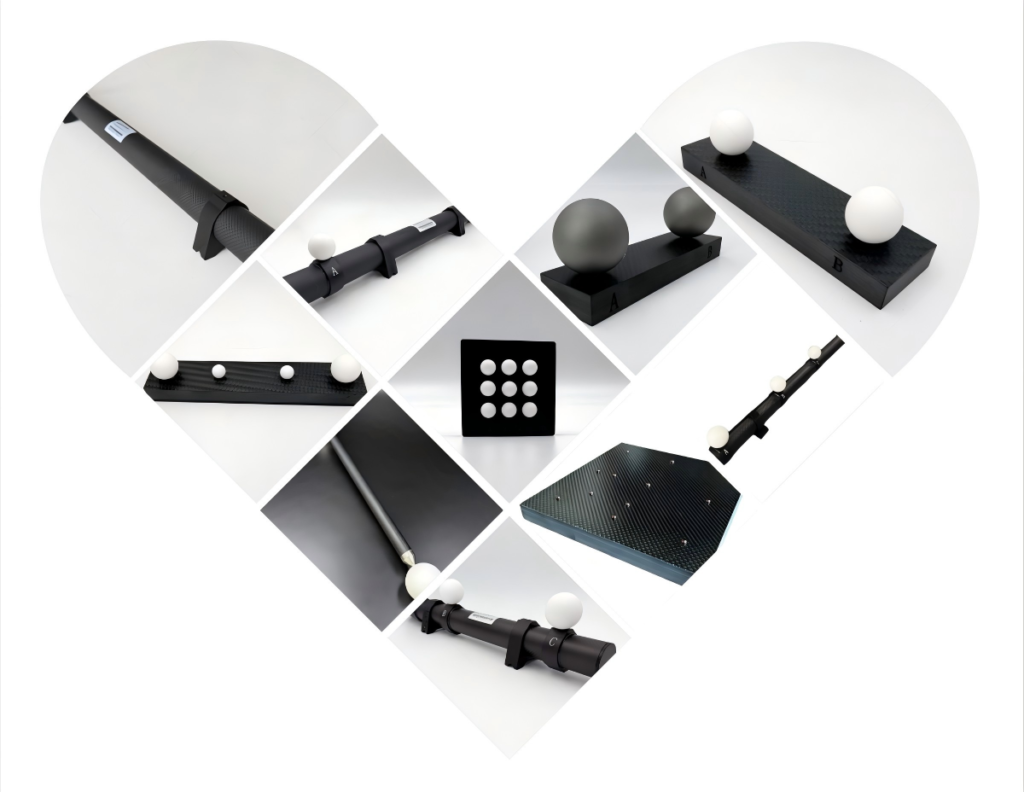
A ball bar consists of two or more precision spheres mounted at fixed distances.
It is primarily used to evaluate:
- linear distance accuracy
- axis alignment
- motion consistency
- short-range repeatability
Ball bars are especially effective for detecting mechanical and geometric inconsistencies in controlled directions.
What a ball plate measures
A ball plate distributes multiple spheres across a flat or structured surface.
This allows evaluation of:
- volumetric accuracy
- spatial distortion
- multi-directional consistency
- large-area behavior
Compared to ball bars, ball plates provide more comprehensive spatial information.
When ball bars are the better choice
Ball bars are preferred when:
- verifying machine alignment
- checking short-distance accuracy
- performing quick system diagnostics
They are simple, efficient, and highly repeatable for linear evaluation.
When ball plates are necessary
Ball plates become essential when:
- measuring large components
- evaluating full working volume
- detecting spatial distortion patterns
In advanced CT environments, a Ruby Plate for CT System is often used because it provides stable multi-point geometry suitable for volumetric reconstruction analysis.
Practical engineering observation
From experience, many engineers start with ball bars and later realize that volumetric issues require ball plates for proper detection.
This transition usually happens when system size or complexity increases.
Final thoughts
Ball bars and ball plates are not competitors.
They are complementary tools designed for different levels of calibration analysis.
Understanding when to use each one is key to reliable metrology practice.