

Why ball plate design matters
A ball plate may appear simple:
A flat structure with several precision spheres.
However, designing a high-performance ball plate requires careful consideration of:
- material selection
- sphere positioning
- thermal stability
- structural rigidity
The design directly affects measurement reliability.
The purpose of a ball plate
Unlike a single calibration sphere, a ball plate provides multiple reference locations.
This allows engineers to evaluate:
- volumetric accuracy
- spatial distortion
- coordinate system consistency
For large CMM systems and optical scanners, this information is extremely valuable.
Sphere arrangement is critical
The position of spheres on a ball plate is not random.
Engineers consider:
- measurement volume coverage
- geometric distribution
- accessibility
- error sensitivity
A well-designed layout allows the measurement system to be evaluated across different regions.
Material selection affects stability
A ball plate must maintain its geometry under changing conditions.
Important material properties include:
- low thermal expansion
- high stiffness
- dimensional stability
Common materials include:
- aluminum alloys
- ceramic materials
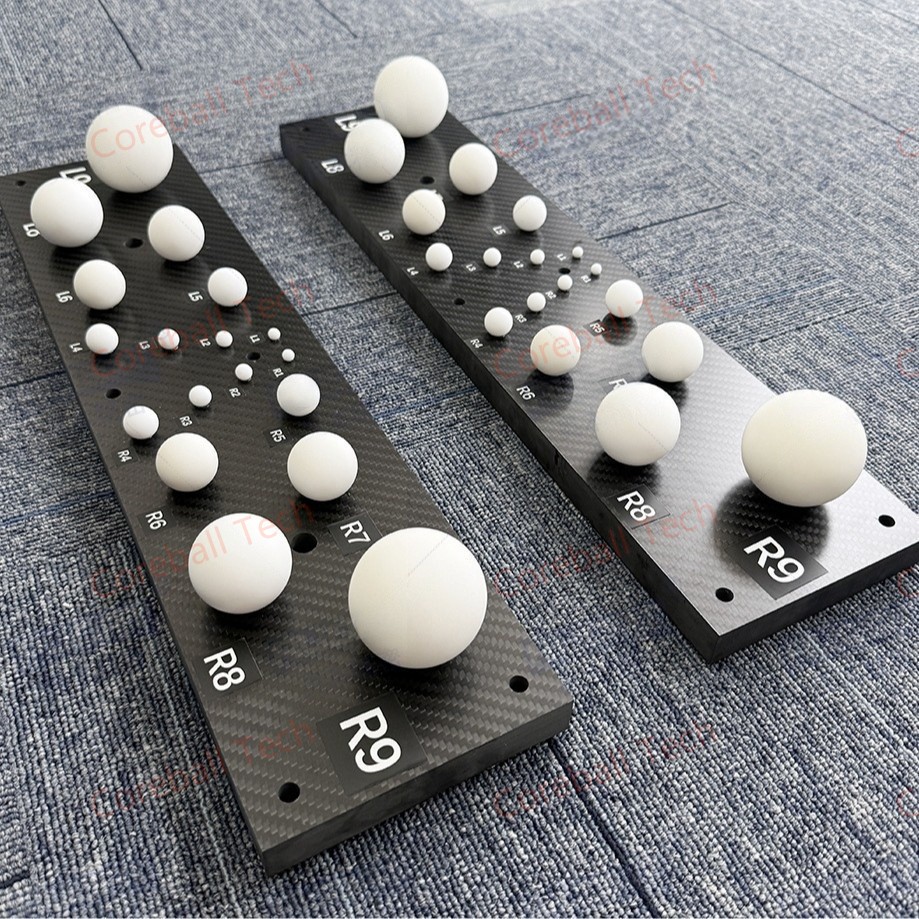
- carbon fiber composites
Carbon fiber is increasingly used in precision structures because it provides:
- excellent stiffness-to-weight ratio
- low thermal expansion
- good stability for large structures
Why lightweight structures are becoming important
Large calibration artifacts create a challenge.
Increasing size improves measurement coverage.
However, excessive weight creates handling difficulties and deformation risks.
Carbon fiber solutions help balance:
- size
- rigidity
- portability
This is especially useful for large-volume 3D scanning applications.
Ball plate applications
Ball plates are commonly used for:
- CMM verification
- 3D scanner calibration
- optical measurement evaluation
- volumetric accuracy testing
For advanced CT applications, stable multi-point reference structures are also important for reconstruction verification.
Engineering perspective
A good ball plate is not simply a collection of precision spheres.
It is a carefully engineered measurement reference system.
Every design decision influences measurement confidence.
Final thoughts
As measurement systems become larger and more complex, the importance of well-designed calibration artifacts continues to increase.
A stable reference creates stable measurement.